
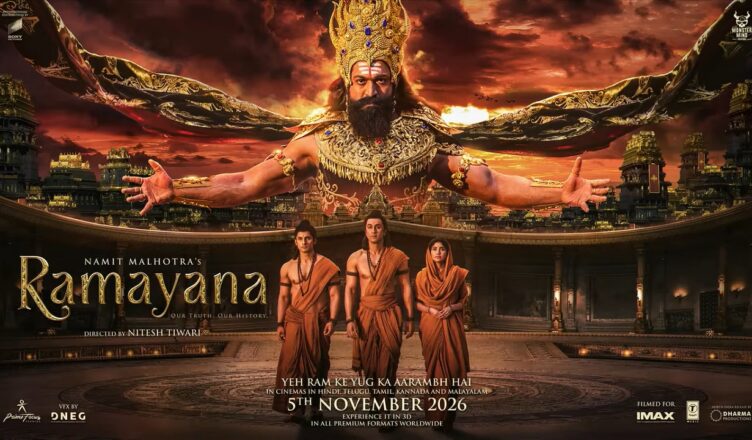
Since many months, Ramayana has dominated conversations and headlines. Finally, the film is here and thankfully, it’s worth all the hype.
The story of the movie: Dashasana, aka Ravana (Yash), defeats the gods and becomes king of Lanka and the three realms. Ravana goes on a destruction spree, prompting Lord Vishnu to take birth in the form of Ram (Ranbir Kapoor) to stop him. Ram is the son of Dashratha (Arun Govil) and Kaushalya (Indira Krishnan). He marries Sita (Sai Pallavi) from Mithila and is all set to become the next king of Ayodhya. However, circumstances force him to go into exile, along with his wife Sita and brother Lakshman (Ravie Dubey), and eventually face off against Ravana.
Ramayana’s biggest strength is that it tells the epic story in a simple yet opulent manner. The VFX is grand and never before seen in Indian cinema and yet it doesn’t overpower the storytelling. The backstory of Ravana is superb and works well as the villain origin tale. Meanwhile, from the dark alleys of Lanka, the story then shifts to the graceful and peaceful atmosphere in Ayodhya. The contrast is smartly presented. Moreover, both tracks run parallel so that viewers don’t get a feeling that either Ram or Ravana’s characters are being sidelined. The effects, as aforementioned, is top-class while the emotions touch a chord, particularly in the interval sequence. The drama is arresting; the action is fantastic and it would lead to hoots and claps. And surprisingly, there’s also humour infused in regular intervals.
What fails to work is the music. It’s a sore point in an otherwise great film. Secondly, the first half is a bit dragging. It doesn’t bore, but there are places in the pre-interval portion where the narrative feels stretched. Lastly, the pure bond shared by Ram and Sita could have been presented in a better manner.
Speaking of performances, Ranbir Kapoor gets into the skin of his character. One gets convinced in no time that he’s playing a pure, principled, godly character and that’s the power of his performance. Yash is aptly cast and takes the impact of several scenes to another level. Special mention should also go to Sharad Kelkar; the voiceover, as expected, is bang-on. Sai Pallavi has a late entry but makes up for it with her beautiful performance. Her dialogue just before the intermission is memorable. Ravie Dubey is too good and is the surprise of the film. He brings in humour to the film. Rakul Preet Singh (Shurpanakha) is terrific and dominates an important position among the ensemble cast. The same applies to Vivek Oberoi (Vidyutjihva). Arun Govil, Lara Dutta (Kaikeyi) and Sheeba Chadha (Manthara) lend able support. Addinath M Kothare (Bharata) doesn’t have much to do initially but makes up for it with his performance in a crucial scene in the second half. Others who do well are Kajal Aggarwal (Mandodari), Kunal Kapoor (Indra), Shishir Sharma (Vasishtha), Ajinkya Deo (Vishvamitra), Mukesh Tiwari (Agastya), Shobana (Kaikashi) and Saurabh Sachdeva (Maricha). Anupam Kher is superb as the voice of Jatayu.
Not a single song works. An important track is missing from the film as well. Hans Zimmer and A R Rahman‘s background score, however, is exhilarating.
Pankaj Kumar and Mahesh Limaye‘s cinematography adds to the big-screen experience. Ravi Bansal and Ramsey Avery‘s production design and Rimple and Harpreet Narula and Saniya Sardhariya‘s costumes are very rich and one can sense that the makers have gone all out. Guy Norris and Terry Notary‘s action is entertaining, but they also draw a line, ensuring that it doesn’t look too filmy. The VFX by Prime Focus deserves brownie points for being remarkably realistic and authentic. Of course, in a few shots, the extensive use of VFX is noticeable, but overall, the visual effects are outstanding and a matter of pride for Indian cinema. Huzefa Lokhandwala‘s editing is unhurried but could have been pacier in the first half.
The story, as we all know, is timeless. Shridhar Raghavan and Nitesh Tiwari‘s screenplay is detailed and captivating. Shreyas Jain and Nitesh Tiwari‘s dialogues are in sync with the era depicted in the film. The funny one-liners are a surprise.
Nitesh Tiwari‘s direction is exemplary. Often, directors known for human stories tend to falter when they are given to handle films of epic scale. But Nitesh comes out with flying colours. One can sense that he’s in firm control of his material as well as the unbelievable scale of the film. At the same time, he maintains a balance and ensures that the grandeur don’t overpower the emotions and the drama. Several characters have limited screen time and yet, they register their presence thanks to Nitesh Tiwari’s direction. What is also truly amazing is how he has executed the action scenes, a first for him.
On the whole, Ramayana lives up to the hype and fulfils most expectations. It is also a matter of pride for Indian cinema, as the film makes a sincere attempt to win over audiences worldwide and prove that Indian cinema can deliver films on par with global standards. Needless to say, this is a must-watch and deserves to be experienced on the biggest screen possible, preferably in IMAX!
My rating – **** out of 5!